Neriad
The Calamitous BobNeriad is the god of courage and purity, also associated with virtuous combat and the moral authority of the church. In the devastated Harrakan Empire, Neriad’s influence survives not as an abstract doctrine alone but through a sacred spring, military vows, funerary prayer, and the institutions that continue to speak in the god’s name. Neriad therefore connects an ancient ideal of honorable action with the practical, often compromised structures of survival after the cataclysm.
Divine Identity and Attributes
Neriad is explicitly identified as the god of courage and purity. Elsewhere, that description is rendered as the god of virtuous combat, linking courage not merely to physical aggression but to a moral discipline governing how violence ought to be used. The distinction matters in a world where soldiers are deployed as expendable warnings, mercenaries abuse outsiders, and military duty is frequently treated as an unpleasant assignment rather than a sacred calling. Neriad’s name supplies the language by which such conduct can be praised, judged, or challenged.
The evidence does not present Neriad through a direct appearance, speech, or visible intervention. Instead, the god is encountered through effects and institutions. A voice of Neriad is assessed as non-dangerous because it follows a path dedicated to advancing church interests through diplomacy and administration, showing that Neriad’s religious sphere includes governance as well as battle. The same association allows a church authority to occupy a position of practical importance, ensuring that forts remain manned and soldiers fed even when the work is administratively difficult and the troops are unwilling volunteers.
Cassia the Unbroken and the Sacred Spring
Neriad’s most tangible surviving sign is the Cassian spring. Cassia the Unbroken was a legendary priestess of Neriad, universally loved for fighting not only for the Harrakan Empire but also for the other nations of the continent. When she died after a long and fulfilling life, the ground opened and a spring emerged. Its waters still carry Neriad’s blessing centuries later.
The spring transforms Cassia’s death into an enduring sacred geography. Her life was devoted to courage in defense of a community larger than one state, and the spring preserves that ideal as a material resource in the ruined Heartlands. It is both a remnant of the lost civilization and an active source of protection: Viviane Saint-Lys survives because of what Cassia did centuries earlier, receiving help from a woman whose earthly life had already ended.
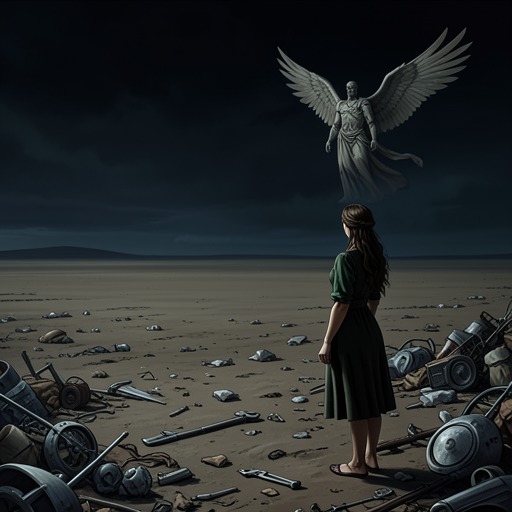
When Viviane Saint-Lys prepares to leave, she returns to the waters one last time and stands before Cassia’s veiled mummy. Cassia’s presence weighs on Viviane Saint-Lys without crushing her, producing humility rather than terror. The moment makes individual achievement appear capable of reaching the gods through deeds, while also reversing the usual direction of worship: the dead priestess has already saved a stranger long after the fall of the empire she defended. Viviane Saint-Lys thanks Cassia and Neriad, and receives no verbal answer, only a comforting presence. Neriad’s continued influence is consequently represented as silent, protective, and inseparable from memory.
Neriad in War and Social Order
Neriad’s name is used to define military service as a sacred duty. Lieutenant Cernit belongs to a multinational corps stationed at the edge of the Deadlands, and Solfis describes him as praising their sacred duty under Neriad’s guidance. The description carries irony because the soldiers are also regarded as expendable, deployed as an early-warning system. Neriad’s ideal of virtuous combat thus exists beside an institution willing to sacrifice the people who supposedly embody it.
The tension between ideal and practice becomes especially visible in the soldiers’ battle cry. Before charging, the knights close ranks and call for Baran and the king. Their invocation is not a direct prayer to Neriad, but it belongs to the same moral and military world in which combat is attached to loyalty, kingship, and collective honor. The scene presents courage in its most physical form while leaving open the question of whether the charge expresses genuine virtue or reckless obedience.
Neriad’s religious authority also extends beyond the battlefield. At Fort Sky, after the fighting, the survivors separate the remains of monsters from the bodies of the lost. The monsters are burned in a pile, while the dead soldiers receive a formal pyre made from the fort’s furniture. Cernit leads prayers during the ceremony and refers to Enttiku, understood by Viviane Saint-Lys as a god of the dead. Although Neriad is not the deity named in that prayer, the ceremony demonstrates the broader religious order in which Neriad’s church operates: war, death, administration, and ritual are treated as interconnected responsibilities rather than isolated experiences.
Church, Diplomacy, and Contradiction
The authority of Neriad is not confined to priestly mystery. It supports a church organization involved in diplomacy, administration, recruitment, and the maintenance of military infrastructure. The potential employer whom Viviane Saint-Lys encounters is recognized as a voice of Neriad whose path promotes church interests through diplomacy and administration. His lack of immediate physical danger does not make opposition harmless; the church’s power is presented as something that can prevail over the long run.
That institutional reach produces a marked contrast with Neriad’s stated virtues. A church administrator is responsible for keeping forts staffed and soldiers supplied, yet many soldiers are volunteers from nearby regions and regard the assignment as terrible. The faith’s language promises virtuous combat, while the social reality includes coercive pressures, logistical neglect, and expendability. Neriad’s presence in the narrative therefore functions less as proof that the institutions are pure than as a standard against which their behavior can be measured.
The treatment of Marruk sharpens this contradiction. Marruk is a female Kark who has recently left what remains of her tribe, and the Kark are undergoing severe hardships amid conflict with the Pure League. The church official insists that Marruk does not deserve the abuse inflicted on her by local mercenaries and vouches for her reliability, explaining that the Kark try to fulfill their promises. Neriad’s authority here becomes a possible defense of an outsider against both ethnic hostility and local exploitation. The scene places purity in an ethical rather than merely ceremonial register: a person’s worth is not reduced to species, political allegiance, or the prejudices of nearby soldiers.
Narrative Significance
Neriad gives the ruined world a surviving vocabulary of moral elevation. The god is linked to Cassia the Unbroken’s transnational defense, the miraculous persistence of the Cassian spring, the courage expected of soldiers, the church’s administrative work, and the protection of an abused Kark outsider. These strands make Neriad a bridge between sacred memory and damaged political reality.
At the same time, Neriad’s ideals do not erase violence or institutional failure. Soldiers can be called sacred while being treated as expendable; combat can be framed as virtuous while appearing foolish; a church can invoke purity while operating inside systems shaped by war and coercion. The narrative uses that friction productively. Neriad’s blessing is most convincing where it survives in acts of protection, remembrance, responsibility, and earned trust, while the institutions invoking the god remain subject to judgment.
Neriad’s decisive significance lies in this combination of transcendence and consequence. The god is never reduced to a visible miracle-worker, yet the Cassian spring and Cassia’s continuing protection make divine influence materially real. Neriad’s name also outlasts the empire’s political collapse, preserving the possibility that courage can serve more than a throne and that purity can mean refusing the abuse of the vulnerable. In a landscape defined by ruins, undead threats, and the normalization of sacrifice, Neriad represents the difficult claim that survival should still have a moral shape.